Here’s how I thought it would go: I would live alone in a strange Midwestern suburb. I would work during the day from my Airbnb, surrounded by fake plants and inspirational-quote posters but grateful to avoid commuting to the hospital where, every night for six weeks, they would snap the immobilization mask over my face and I would lie there, trapped and terrified, while they fired a modified nuclear weapon at my brain.
If my outlook seems bleak, well, I’d had a rough year. I’d gone to the optometrist expecting to update my glasses prescription, but discovered I couldn’t see out of my left eye. As it turns out, this is an alarming symptom, not only to experience in the moment but also to frantically Google on your phone while waiting for the optometrist to consult a second optometrist. The only available explanations for my vision loss were weird ones (cat scratch fever; ocular herpes) or scary ones (MS; brain tumor). “Have you by any chance been punched very hard in the face?” asked the second optometrist. I hadn’t. “That’s too bad,” the second optometrist said.
After an agonizing month, I was diagnosed with a brain tumor, thankfully benign but, two failed surgeries later, still hopelessly stuck to both optic nerves and my carotid artery. If the tumor grew, I risked going blind. Radiation would probably prevent this growth, but it came with its own significant risks, ranging from likely-but-bearable to unlikely-but-devastating. And these side effects could take years to manifest. That was good news, I supposed, but also not: I’d have to spend all those years worrying.
Still: I was lucky, wasn’t I? The tumor was benign! I had health insurance! I had the time and education level required to fight for months on end with said health insurance to get my treatment covered! I still had one good eye! Maybe none of this was a big deal; maybe the worst of the chronic conditions I’d have to learn to live with were endless uncertainty and dread. And that was basically just being alive, right? Or at least, better than being dead?
By the time I started radiation, I was exhausted, physically and mentally. I was also convinced that my luck, as it were, was bound to run out. I was shaking when I left for the first treatment, but I took a deep breath and headed out the door.
Which is when things got weirdly, overwhelmingly…fun.
✦
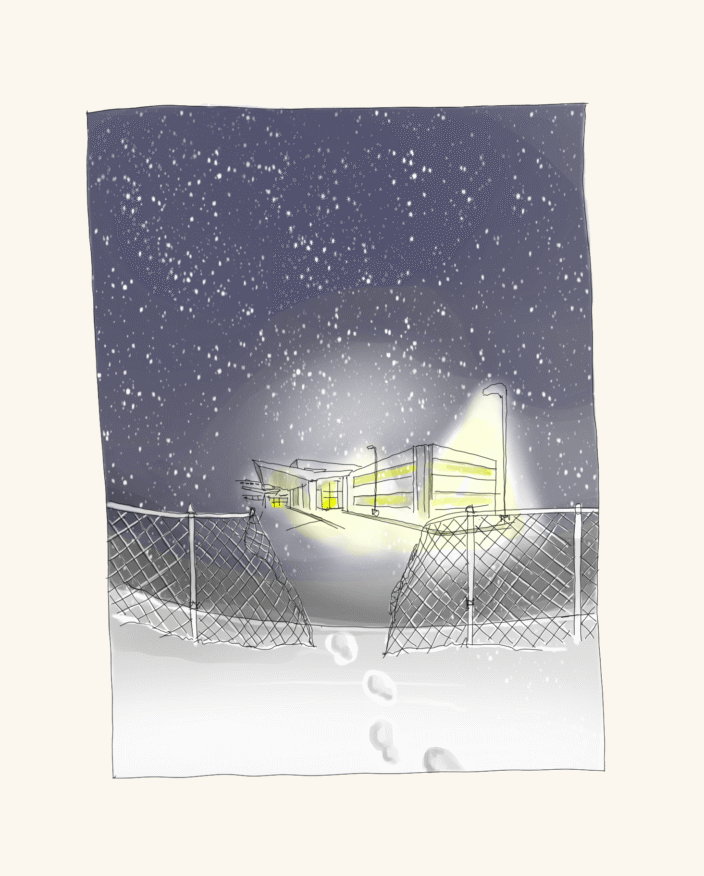
First, it was the walk. It looked longer on the map, but I discovered a hole in a fence that deposited me right at the edge of the hospital parking lot. This was not only convenient, but also vaguely mischievous, a little magical. It was very cold and very quiet and the snow flickered like static in the streetlights.
“You WALKED here?!” exclaimed the desk attendant, stepping out from behind his plexiglass enclosure to aim a thermometer at my forehead. “Well, that must be why you don’t have a temperature.” He showed me the screen: LO. “Unless you’re by any chance a zombie?”
“It’s a short walk,” I explained, now vaguely embarrassed, but the desk attendant was already spreading the news: “She WALKED here!” he exclaimed to the two nurses who had materialized to lead me to my fate.
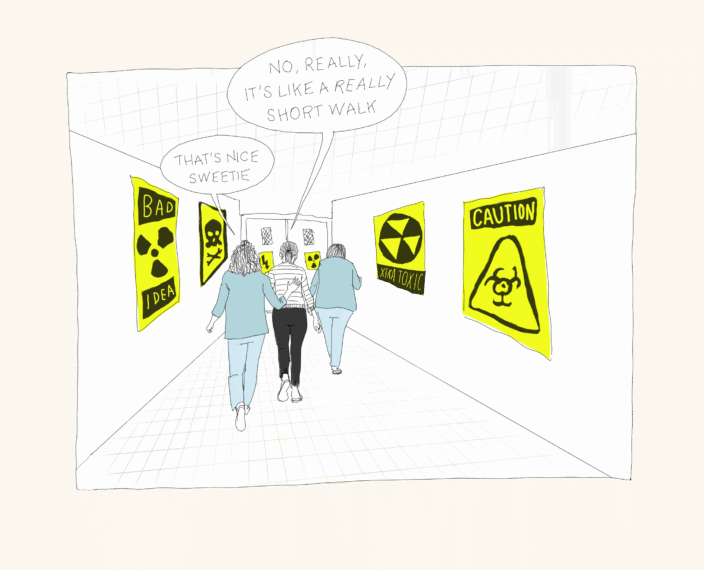
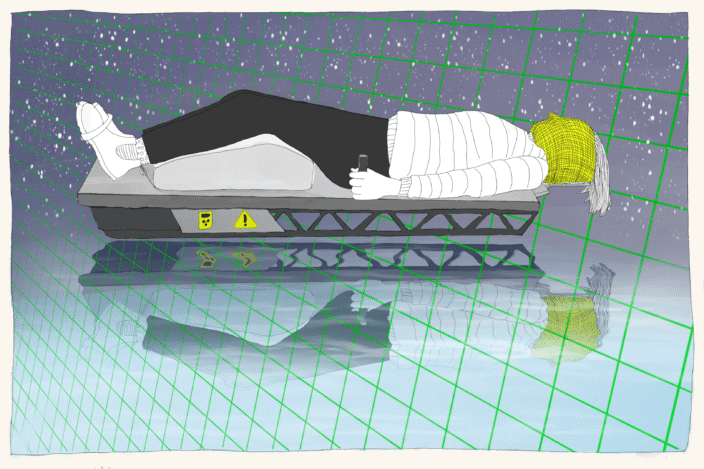
The treatment room looked like the set for an astronaut movie: high-tech in the middle but mundane around the edges. “Is that the machine?” I asked, pointing at a large robotic arm protruding from the wall.
“The whole building is the machine, hon,” said one of the nurses. “In here are just the parts you can see.”
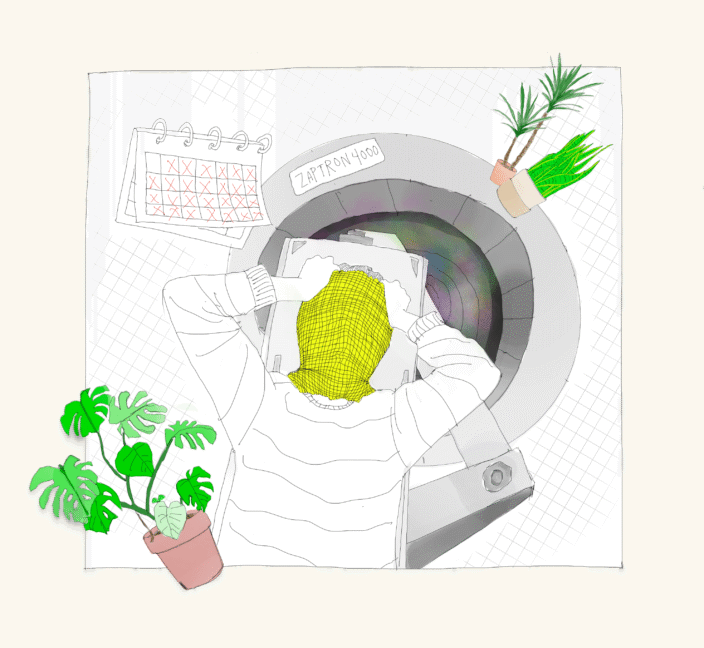
Physically speaking, the treatment itself was much like I’d imagined: the mask pinning my head to the table was stiff and uncomfortable, especially where it pressed against a screw in my forehead that had never quite settled after the first surgery. But it was also strangely peaceful. The whole process took about 20 minutes, only a few of which involved the actual delivery of radiation—the rest was the machine moving around, making its precise calculations, scanning and readjusting and beeping inscrutably. The mask was too tight for me to open my eyes, so I was forced to focus on other sensations: the pillow under my knees, the band around my feet, the smooth cylinders I’d been instructed to grip to keep from fidgeting. My breath coming, going, coming, going. It wasn’t that I’d forgotten the past or the future. It was just that for once I felt calm between those poles, instead of ricocheting from one to the other. Like the mask had stilled not only my head but my mind.
✦
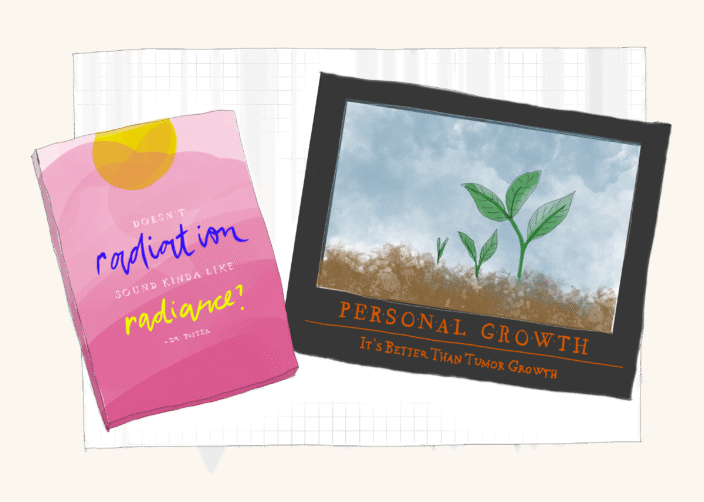
The calm feeling persisted beyond the treatment table, and, to my surprise, it seemed to breed moments of joy. Back at the Airbnb, I rearranged the fake plants. I took the inspirational poster-quotes to heart: I looked on the bright side, and I made each day my masterpiece—why not? And I relished the walk through the snow, the hole in the fence, the crisp air. “Still dead?” the attendant—Andy—would greet me, aiming his thermometer at my forehead, which was always too cold to register. “Still dead,” I would confirm. Then I would hop on the table for my nightly practice, the enforced mindfulness meditation that was proving more effective than any of my previous efforts.
I had struggled, in those mindfulness efforts, with the idea of presence in particular. Sure, I’d felt the momentary relief of derailing a runaway train of thought by attending to my breath, but that’s all it was: momentary. Besides, I didn’t really see the point. Was I supposed to just watch my breath…forever?
This, though, was a different kind of presence. It wasn’t the fragile presence I’d experienced in the month it took to reach a diagnosis, when the possibility that the tumor might be the kind that would quickly kill me yielded moments so precious they verged on saccharine. And it wasn’t just a quick break between anxiety spirals. This presence was more durable, expansive: a light I could shine on everything at once.
What had turned the light on? Was this presence only possible under pressure? There was the unmissable nightly appointment, of course, but also other kinds of pressure, both literal and figurative: pinned to the treatment table, was the future—and, for that matter, the recent past—simply too scary to consider? Was presence a strain of avoidance, a false refuge from the inevitable storm?
One day, right at the crown of my head where they’d said I might lose a patch of hair, a single curl sprung straight up, kinked as a pig’s tail. When I saw it in the mirror, I burst out laughing. But that night at the hospital, I suddenly imagined myself swimming. I felt myself falling away from the table, out from under the tight grip of the mask, and into a cool lake. The water closed over my head and I hung there, suspended in the liquid quiet, then burst to the surface, where the sunlight turned everything to glitter and I could see it all, every sparkling detail, with both of my eyes. It was neither a memory nor a wish—it was like glimpsing another timeline. This vision ushered in a sadness so sudden and overwhelming I wanted to shake my head to etch-a-sketch it away. But I couldn’t move, so I stayed there as it passed, like weather, over and through me.
“Still dead?” Andy greeted me the following night, then added: “Nice hairdo.” I reached up and flicked my curl, which sprung back into place. Like some dumb flower that had sprouted through the crust of snow, bright, hopeful, doomed.
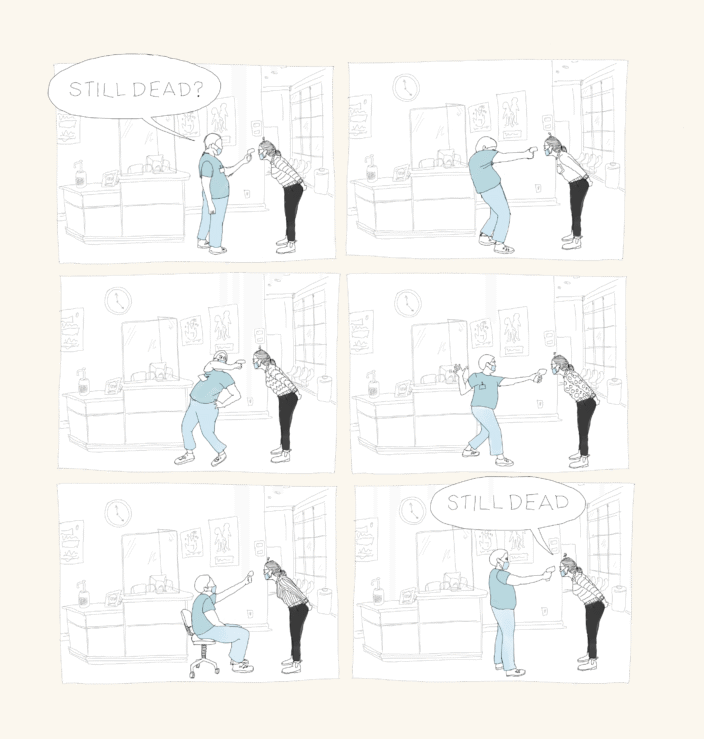
The last week was the coldest, dropping into the low single digits. “You walked in THIS?!” Andy exclaimed.
“Yes I did!” I responded, appropriately exuberant for once. It was, after all, a kind of miracle.
After the final treatment I rang a giant ceremonial bell and received my Graduation Certificate, signed by Andy and the nurses. “Do you want to keep the mask?” they asked.
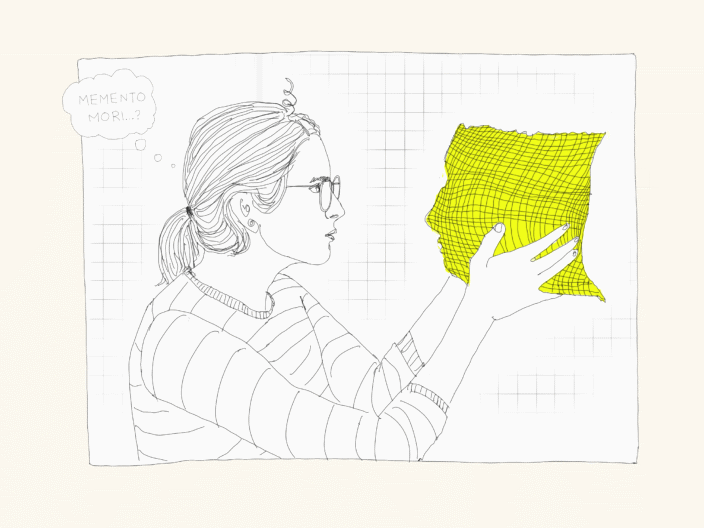
I carried it home awkwardly, like a stranger’s baby. I put it on and took a selfie. I was a blank slate, faceless. A moment of vertigo: what had happened, what might have happened, what might happen next.
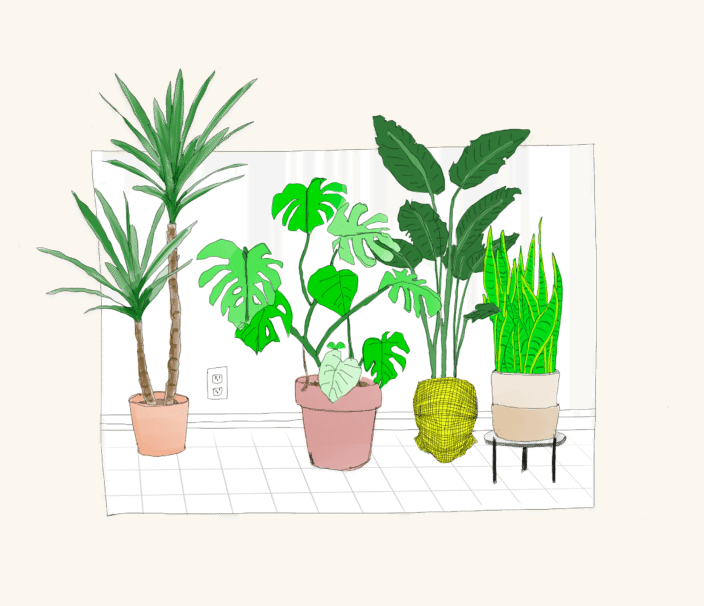
I returned to my breath. What was happening now? I was very happy, and very sad. I was so lucky, and aching with loss: of the vision I would never recover and, with it, the sense of anything as recoverable, of my body as a body that could heal back to something like wholeness. It was a big deal, what had happened to me, and also wasn’t, because worse things happened to other people every day—but if I stayed in the present, I realized, I could hold all of it, could be frightened and hopeful, bright and doomed, fully aware of both my own relative health and the tender scalps of the chemo patients I passed in the hospital halls. The present was no refuge. It wasn’t a place you went to avoid having to think about stuff. It was just a bigger place—a place spacious enough to accommodate all of the contradictory truths at once. I could let go of the past and the future with their what-if driven logics. I knew the plants were fake and I was grateful, every day, for their green.
 After reading Ali’s essay we revisited Susan Sontag’s Illness as Metaphor, published in 1978. Its now ubiquitous phrase, “the kingdom of the sick,” appears in the first lines:
“Illness is the night-side of life, a more onerous citizenship. Everyone who is born holds dual citizenship, in the kingdom of the well and in the kingdom of the sick. Although we all prefer to use only the good passport, sooner or later each of us is obliged, at least for a spell, to identify ourselves as citizens of that other place.”*
Ali’s treatment happens in the “night-side” of life, the upside-down, topsy-turvy, everything-is-akimbo state of being sick (and also, literally, at night). Illness memoirs have become fairly commonplace, but, at their best, they capture the experience of existing in that liminal space, the country just on the other side of “normal” life where nothing and everything has changed.
We put together a list of some of our faves from the genre:
- The Invisible Kingdom: Reimagining Chronic Illness by Meghan O’Rourke. Part memoir, part reportage. O’Rourke recounts her decade-long struggle with a mysterious autoimmune illness and how the medical system failed her. (For a quicker hit, this essay is the basis for the book.)
- The Bright Hour: A Memoir of Living and Dying by Nina Riggs. Somehow this story, about having terminal breast cancer while raising two young sons, is hopeful, beautiful, and funny.
- Between Two Kingdoms: A Memoir of a Life Interrupted by Suleika Jaouad. The story of a leukemia diagnosis in her 20s — and the overwhelm of what’s supposed to come next after years of treatment.
- Dying: A Memoir by Cory Taylor. Written in the final months of her life, Taylor reflects on mortality, autonomy, and what it means to die well in a culture that fears death.
- Brain on Fire: My Month of Madness by Susannah Cahalan. A journalist recounts her sudden descent into psychosis, and the 11th-hour diagnosis of autoimmune encephalitis that saved her life. Reads like a thriller.
Love a title we missed? Let us know. We heart a virtual book club.
✦
*We would be remiss to bring up Sontag’s essay and use it only as a soundbite. The heart of her argument is that illness should be understood literally, not metaphorically: Seeing disease through a moral, emotional, or symbolic lens only stigmatizes patients and distorts our understanding of illness itself. (Keep in mind that, at the time, AIDS was seen as divine punishment and cancer as a symptom of emotional repression.)
Illustrations by Ali Shapiro.