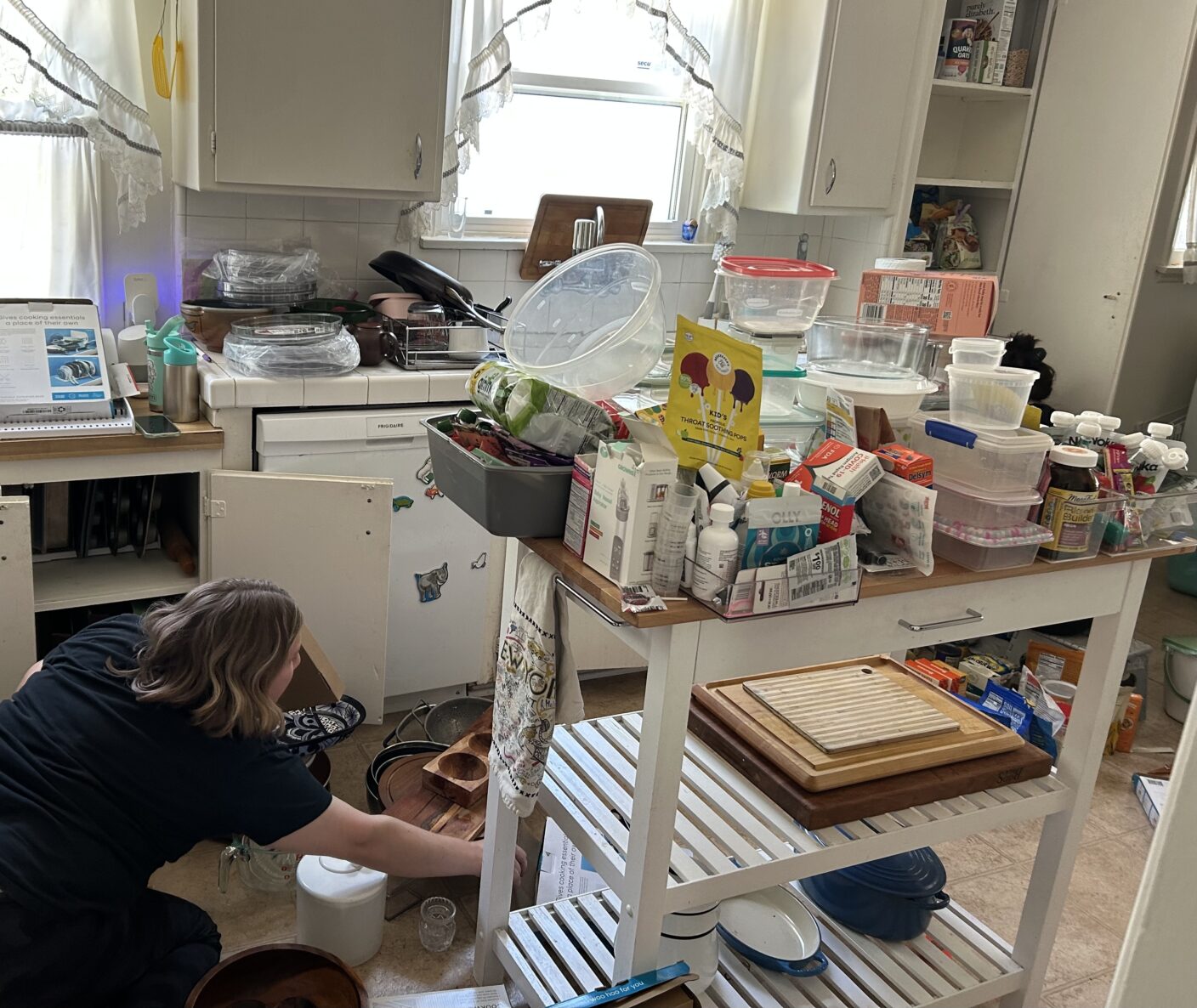
 Let me tell you about my kitchen. It’s roughly 85 square feet, with yellowing linoleum floors and wonky cabinets in a rented house I share with my husband Corey and our two young kids. Until a few months ago, it was messy. Like, really messy. (Once, my friend Lavinia gently ribbed me: “What’s with the tampons on top of the microwave?”) I am a low-grade slob who’s fairly unbothered by a small pile of clothes or unruly stack of newspapers. But the kitchen was making me miserable.
I was often prepping food with a toddler on my hip, and couldn’t find the things I needed. When I could, I wasn’t able to easily extract them one-handed. We were wasting money on ingredients we already had, because we couldn’t see them. I hated unloading the dishwasher because so few items fit easily in their places. When Corey did it, he’d hold up items and ask, “Where does this go?” And I’d react with rage because how the fuck should I know? What am I, a trad wife?
The kitchen, it turned out, wasn’t just cluttered with Tupperware lids and bags of Cheddar Bunnies. It was overflowing with inherited gender roles and layered with resentment and shame.
Let’s back up.
✦
Having kids changed my place in my relationship and home. I didn’t return to my full-time journalism job after maternity leave, opting to focus on my kids and freelance instead. Corey became our primary breadwinner, while I took on more domestic responsibility. This choice felt, and feels, like a huge privilege. But I hadn’t truly considered how much that “domestic responsibility” would include stuff other than our newest family members. Literally, all their stuff.
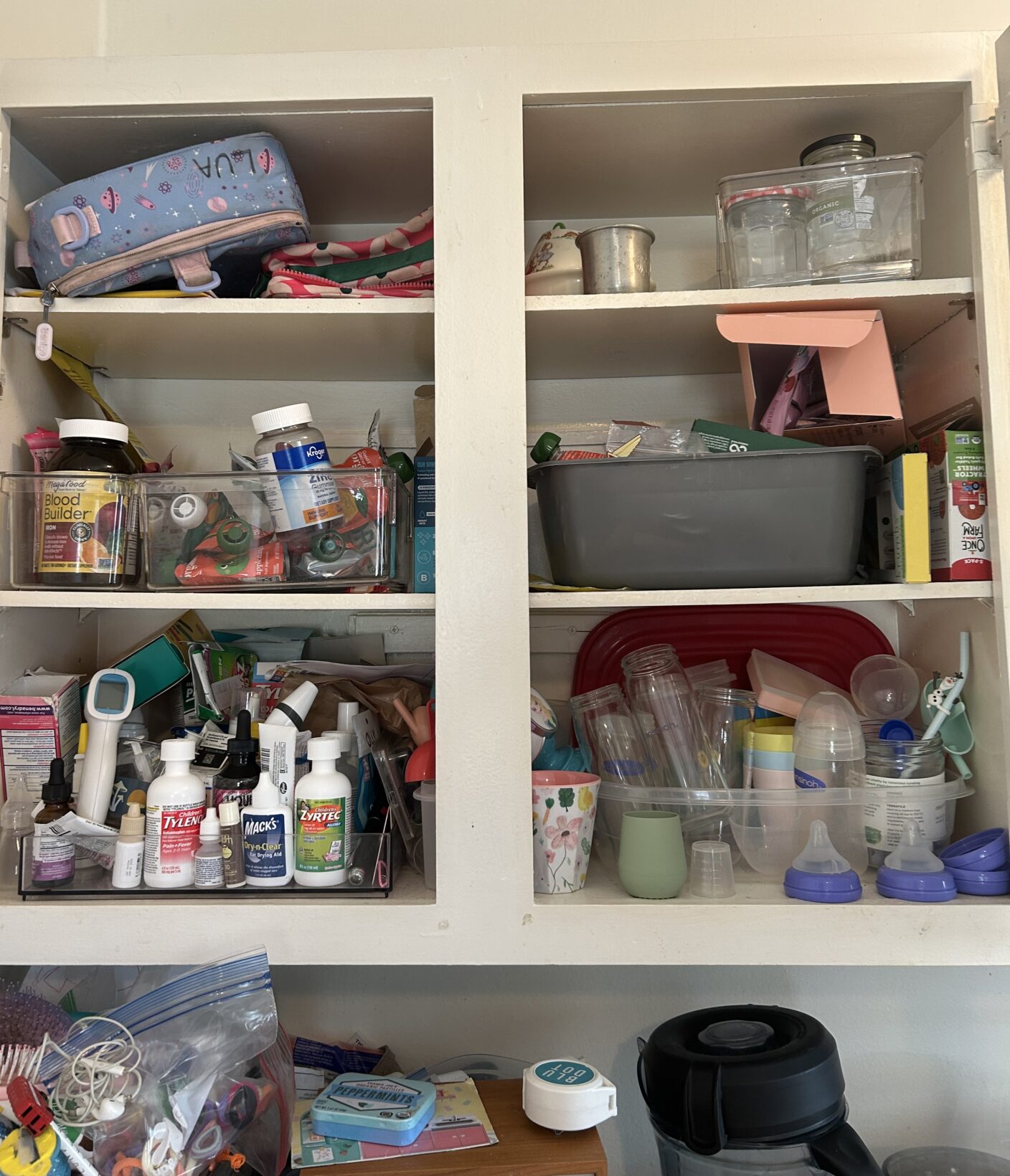
And, wow, was there stuff in our kitchen — specialized, modular, never-quite-dry stuff. First there were bottles, nipples, pacifiers, bibs, a sterilizer. Then, little spoons, snack containers, and sippy cups. I once loved to cook, but I chafed at being responsible for this kitchen — and resistant to taking ownership of its mess. I told myself a few different stories about this resistance, all of which contained some truth:
- I didn’t sign up for a partnership where a disorganized kitchen was my problem alone, and taking it on would represent a surrender.
- I rejected the pressure to be Instagram-perfect. Letting friends see our dish rack Jenga was a generous act of vulnerability. (Bless this mess!)
- I had better things to do than sort out the kitchen. Obviously.
I felt trapped by these stories. It was like the “cool girl” of the 2010s all over again. You know, the one who always looked hot, but never like she tried — and would probably laugh off a sexist joke? A decade after recognizing this impossible quagmire of effortless excellence, I felt pressure to be the cool mom: make this kitchen functional without trying too hard — or worse, getting mad about it.
Beneath all of this, I was just doing the best I could.
✦
I was aware of the existence of professional organizers, but never considered hiring one. They struck me as mercenaries of consumer culture, armed with label-makers and acrylic containers, color-coding cashmere sweaters for their bougie, materialistic clients. Then, in The New Yorker, I learned of anthropologist Carrie M. Lane’s book More Than Pretty Boxes: How the Rise of Professional Organizers Shows Us the Way We Work Isn’t Working. Lane illustrates how this growing industry attributes value to skilled work that women are often already doing — or, in my case, failing at — for free in their own homes. Her nuanced perspective made me realize my assumptions about organizers were both snobbish and sexist.
“In small, everyday ways, organizers work to lighten the load society has placed upon women, and that women in turn enforce upon themselves,” Lane writes. Professional organizing gives this previously invisible “worry work” a name, and a price.
I was ready to pull the ripcord and pay.
✦
On the kitchen’s D-Day, I happened to be on a high-pressure editing deadline, so when Cheryl Arzewski — a true professional, recommended by a trusted friend — showed up with a domestic SWAT team of three women in black tee shirts and a coffin-sized rolling bag full of gear, I quickly showed them the kitchen and absconded to my office a few feet away.
When I peeked into the kitchen periodically, I saw that the contents of every shelf, cabinet, and cranny had been emptied onto the countertops, dining table, and floor. Items were re-categorized. Shelves were wiped clean. Around lunchtime, a fifth team member appeared. And lo and behold, by the day’s end, containers were reunited with lids. Baking dishes were filed into a freshly installed rack. Sauces and vinegars were spinning on lazy Susans. Granola bars were expelled from their boxes, lined up like soldiers in clear containers. Applesauce pouches stood at attention. Everything was labeled.
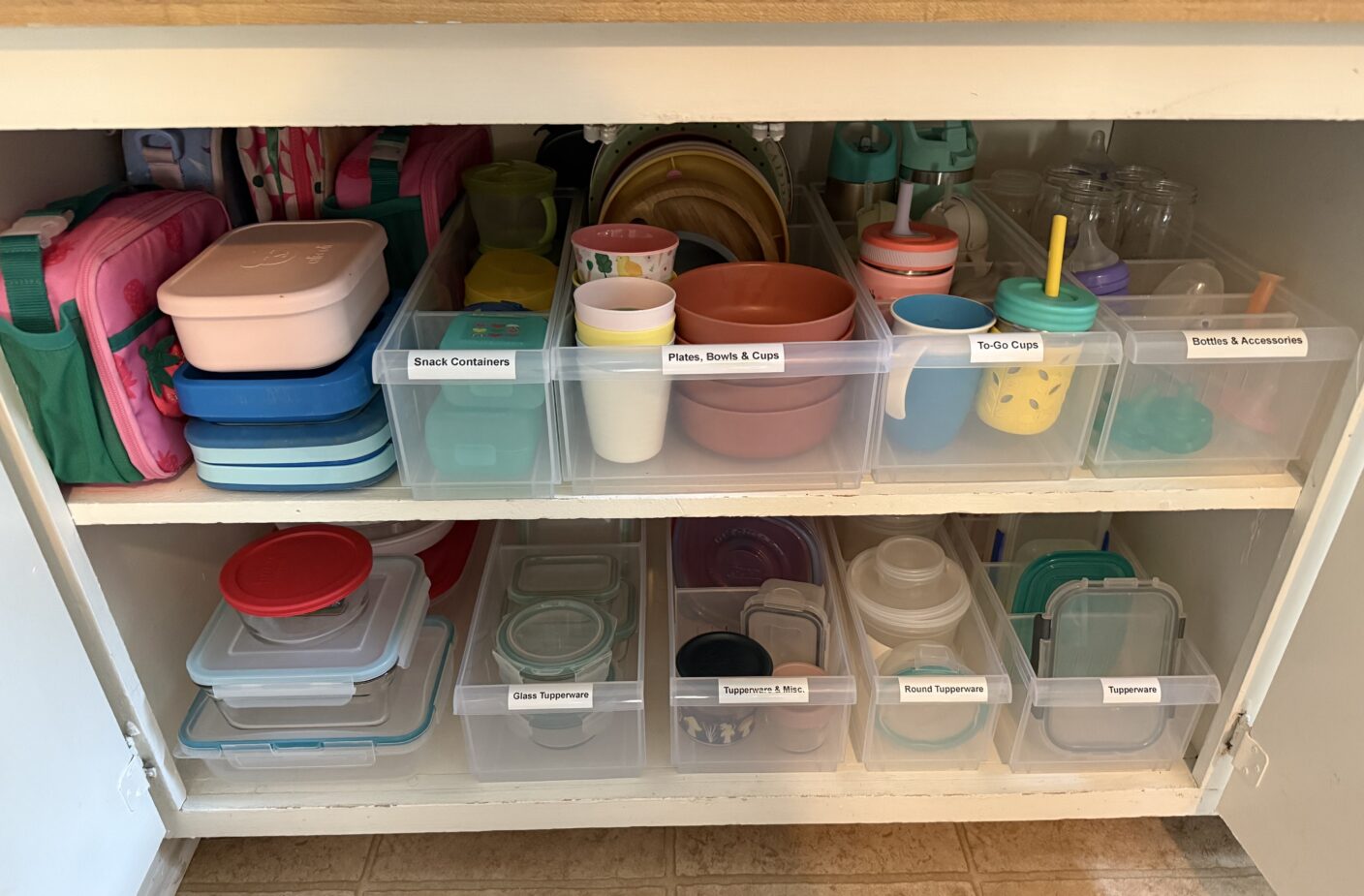
Afterward, Cheryl told me my kitchen re-org was one of her most challenging jobs, due to its small size, bizarre-shaped cabinets, and sheer volume of contents. I found this validating: It had been difficult for five people to do the work I had been beating myself up for being unable to achieve. Five professionals.
Several months later, the benefits endure — not only for the kitchen, but for my marriage and my mental health. (Professional organizers: cheaper than divorce!) Cabinets and drawers close easily. I can finally find things. Labels keep everyone accountable for putting things away properly. And my identity crisis about being a sometimes stay-at-home mom isn’t triggered every time I enter the room.
That’s not to say my complicated feelings have resolved completely. I’m still angry that this work falls largely on women, while everyone reaps its benefits. And while I don’t really want to be a homemaker — homemaker!? — who’s obsessed with neatness, I see how much a tidy space eases the stress of balancing paid work with caring for my family.
Unfortunately, it seems the simplest way out of the “cool mom” trap is, frankly, to be a rich mom. Lane gets at this in her book:
While this system of hiring women to perform the previously unpaid labor of other women assuages some of the pains of contemporary life, it also distracts attention from systemic problems around the way Americans are expected to work today, both in paid positions and in their unpaid labors for the household.
Fixing these systemic problems will require implementing a social safety net with benefits like federally supported childcare and family leave — instead of relying on women to pick up the slack. Those bigger-picture fixes call for a different kind of organizing. In the meantime, I wish I could just hire Cheryl to fix our entire house. But, alas, we can’t afford her.
So instead, I try to have “What Would Cheryl Do” moments when faced with an untenable tangle of stuff. First, she would lay everything out where she could see it. She would approach each item with dispassionate detachment: “Do you use this?” If not, goodbye. She’d categorize the remaining contents. Then, she’d look at the available space and find an orderly storage solution.
In other words, she’d treat the situation like work, instead of a referendum on her entire existence. Having pulled all that shame and ambivalence out of the overstuffed cabinets, I was able to see it clearly — and put aside the parts that no longer served me. Because sometimes, a mess is just a mess.
 Jenni’s essay captures the bind in which many partnered straight women find themselves — and some of those women are feeling pretty pessimistic. After all, it’s hardly a new bind. As Judy Brady asks in her 1972 essay I Want a Wife: Given all the roles typically assigned to women in marriage, “My god, who wouldn’t want a wife?”
For a more contemporary take, try this recent SNL sketch about three men whose wives “vanish without a trace” — it’s sure to provide a few lols (or lolsobs, depending on your POV).
If your household could also benefit from some reorganizing, check out Fair Play, a suite of materials (book! documentary! actual playing cards!) designed to help folks notice and correct imbalances in domestic labor. Author Eve Rodsky researched how couples divide responsibilities and discovered, across many demographics, “the notion that men’s time is finite and women’s time is infinite.” (🙄) Intrigued? Appalled? A little of both? Start by making your own version of Rodsky’s “Sh-t I Do List” — a list of everything you do “in service of” your household, quantified in terms of time — and sharing that list with, ahem, anyone who might need to see it.
To calm down from all that imbalanced gender, you could scroll through Things Organized Neatly, a tumblr dedicated to the beauty of, well, things organized neatly. Ahh, the tranquility of this perfectly arrayed, color-coded barrette collection. Who knows, maybe your silverware drawer could be the next stunning display.