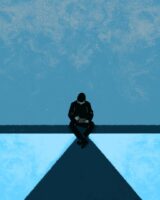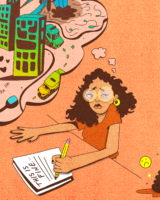
It is college and I’m lying in my twin bed, eyes fixed on the ceiling, begging for the sweet grip of unconsciousness.
This is when I first realized: I’m bad at sleep.
✦
College is, of course, famously anti-sleep. You’ve got kids on caffeine pills and Red Bulls trying to physically fight the Sandman so they can cram for a final. But I’m not talking about that self-induced insomnia. No, I’m thinking of lying in your dorm bed for hours, tossing and turning, trying to keep your eyes closed and not succeeding until you’re in your early morning “Intro to Botany” class. That’s what it looked like for me, anyway.
As if that weren’t bad enough, my anxiety produced a terrifying tic — I started fixating on my own breathing at night, feeling like I couldn’t get a deep enough gulp of air. A very nice doctor told me this was psychosomatic, or, in other words, “It’s all in your head.” But that didn’t make it any less real.
It affected my waking life too. I was forgetful, got frequent migraines, and had little energy. I’d go about my day dreading bedtime because I knew I was in for another eight or so hours of torment. This expectation made my anxiety worse, which worked in a self-sustaining loop to ensure I never got any shut-eye.
I tried all manner of wild antidotes to my plight. I dabbled in vitamins, every brand of sleeping pill (these only succeeded in making me numb while awake), and YouTube channels that specialized in producing theta waves, a frequency of sound that is supposed to quiet your mind. They all failed, though I would occasionally listen to the theta waves during the day for a spooky, chill ambience.
A big part of the problem was that I viewed sleep as a task. Being a perfectionist, the more I failed at it, the more frustrated I became. And the more flustered you are, the more difficult it is to fall asleep.
It wasn’t until I nearly lost my media job in New York City due to my mushy, sleep-deprived brain that I realized, “I absolutely can’t continue like this.” My boss called me into her office one day and told me it seemed like I was struggling to be present. It was true, I was taking frequent trips to the coffee maker (and even more frequent trips to the bathroom) and was unable to focus during meetings. I had to make a change.
✦
If this were another essay, this would be where I talk about how I overcame this challenge. Hurdles, after all, are meant to be leapt over. But this is the exact mindset that made sleeping such a problem for me. And it’s a mindset that permeates American culture — the idea that if we encounter adversity, we just need to push ourselves to conquer it.
I do regularly get a good night’s sleep these days. So, worry not, there’s a happy ending. It’s just that getting there was more like a shift in thinking than a shift in what supplements I was taking. What I found, after years of troubleshooting, is that my approach was all wrong. I didn’t understand that sleep and rest were different things.
✦
Rest is what saved me.
One is more of a necessary biological situation: I am asleep. The other is a conscious tilting of one’s brain gently toward acceptance, toward productive surrender. It’s difficult to illustrate rest without relying on paradox, because good rest feels like a state of nonbeing, which is hard to achieve. It’s like effortfully attempting effortlessness.
Rest can be brought to almost any activity in our waking hours. For example, when I get in bed these days, I don’t think, “We need to get to sleep as soon as possible.” I used to tally up how many hours of sleep I’d get if I passed out right at that moment, and it made me want to strive for that goal. If I didn’t reach it, I’d be upset with myself.
Rest looks more like: I’ll get to sleep when I get to it. If all I do here is relax for now, that’s fine. It’s intentionally lowering the stakes to allow the brain more room to spread out and do what it needs to do. Most importantly, I don’t reserve this mindset just for the nighttime.
Active rest looks like carving out time during the day to just be. I felt overwhelmed by emails last week, for example, and instead of panicking I thought, “Can you read just one you’ve been dreading? Just one.” I don’t pile the whole to-do list on at once. This makes life less of a pass/fail, which, to an overthinker, is crucial to finding peace.
It might sound easy, but this way of thinking can be hard to access in our “grind” culture. It was that mindset that interrupted my sleep — there are all these things I could be doing, things I should be doing, things I’m going to get to right when I wake up.
But rest isn’t just lulls between productivity — it is a destination. Yes, not checking Twitter at night helps, as does, say, making a hot cup of decaf tea and reading a relaxing book. But unless we’re willing to accept that we still might not get that perfect sleep we’re after, then it will be for naught. We’ll just be awake and cranky — only, with tea.
I no longer think of sleep as a chore, and indeed, I’ve “de-chored” a lot of things I used to dread. Where heaps of dirty dishes used to clutter my sink, there are now opportunities to listen to podcasts while I mindlessly set about scrubbing. When I cook, I’m not after a picture-perfect meal worthy of Iron Chef. I’m okay with just getting myself fed for the evening.
With everything happening in the world right now, a small silver lining is the opportunity to completely rearrange not only our routines, but the thoughts we bring to the process of completing them. The truth is, I don’t always get a perfect night’s sleep. I don’t always get in the hours I’d like, or the feeling of rejuvenation I’d prefer to wake up to.
The difference is I can accept that now. I can try again, or better yet, not try, tonight.
This line from JP’s essay, “Active rest looks like carving out time during the day to just be,” reminded us of the work of Tricia Hersey, founder of The Nap Ministry. As its name suggests, The Nap Ministry is about celebrating naps, but it’s really about using rest as a form of resistance against deeply embedded values of capitalism and white supremacy — a way to push back against grind culture that mandates productivity at all costs.
“Yes, it’s about literal naps, but it’s also about imagination work, justice work,” Hersey told The New York Times. “It’s about education: We need to understand what the systems are doing to us, so that we can resist in a way that is fruitful for us.” Translation: Resting is political.*
If sleep is elusive, it makes sense that we’d go hard on sleepmaxxing and load up on gadgets and supplements that might help, but when have we crossed the line and turned sleep into part of the hustle?
If active rest and rest as resistance are ideas that speak to you, here are a few books to read while lounging:
- Rest Is Resistance: A Manifesto by Tricia Hersey
- A Burst of Light and Other Essays by Audre Lorde
- Sisters of the Yam by bell hooks
- The Collected Poetry of Nikki Giovanni
- A Room of One’s Own by Virginia Woolf
✦
Prism is not responsible for any mid-work naps inspired by this piece. But we do encourage them.
Illustrations by Thomas Colligan.