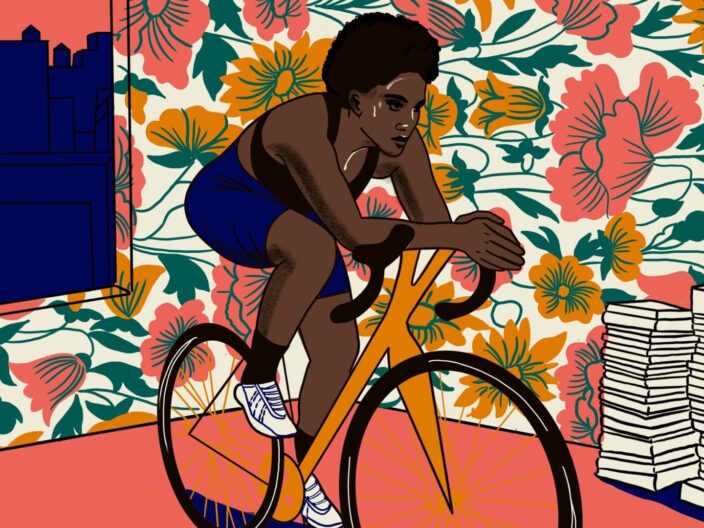
I remember the exact moment of my breakthrough. I was 45 minutes into a blitz exercise where I had to alternate between furiously pedaling on the stationary bike and pushing a sled back and forth. I’d never driven myself to the brink like this before, and I was psyching myself up to fail. But I made it. After the cool down, I thought I was going to cry — I was so proud of what my body could do and perhaps a little ashamed I underestimated its strength. I held my head up higher that day and my workouts haven’t been the same since.
✦
Growing up, I was never a big fan of physical exertion of any kind. I was the kid with a pudgy stomach and rapidly developing body over which I felt I had little control. Every day when the PE teacher would open the door to the track, my heart would start galloping because I knew what would come next — and how far behind the rest of the class I would be. While I was catching my breath in the locker, hurrying up to change before the bell rang, my other cohorts would already be finished and ready to go.
One of my sisters was a track star. She broke records, and my mother and I would travel all over Jersey to watch her compete. I, on the other hand, preferred to watch television. I couldn’t run a half a mile under four minutes but I could tell you the plotlines in all the major Saturday morning Nickelodeon shows.
Naturally, I became a writer, which required no movement at all unless you counted the 10 centimeters I rolled in my chair from my bookshelf to my laptop. I could spend hours at my desk typing or brainstorming. The majority of my exercise happened in my brain where the amount of reps would correlate to how many times I circled around plot developments. The rest of my body was neglected. I made up a ton of excuses: Writing was demanding enough. I couldn’t exert mental energy and physical energy on the same day. But when I was a freelancer and both my personal and professional life were merged inside a cramped studio in Harlem, I needed to do something.
✦
The turning point came when my physician told me that I was pre-diabetic. Though I’d never been a stranger to sweet, salty, or fried foods, no doctor had ever given me an update like that before. Diabetes and high blood pressure are very common on my mother’s side of my family, and I didn’t want my later years to be marked by doctor visits, blood tests, and needle pricks. I also was afraid of the more harrowing risks: blindness, limb amputation, you get the picture. So I signed up for a women’s gym and started with a personal trainer who was also a dancer twice a week. This particular gym seemed ideal because there wasn’t an emphasis on a Hollywood body but rather a balanced attitude towards strength and endurance. I was nervous anyway, but my trainer was warm and encouraging. The progress was gradual. Maybe one week, I would go up in kettlebell weight or I could hold a plank for 15-30 seconds longer. Perhaps I’d crouch lower in my squats or jump higher in my knee tucks. Though I couldn’t stand exercise, my trainer, or myself certain weeks, I couldn’t deny the bliss after a workout was done. That mood sustained me throughout the whole day.
Soon, I started to look forward to my training sessions and began supplementing them with the hardest HIIT and bootcamp classes I could find. Even if I was one of the last to finish an exercise, I was still happy. Ultimately, I realized that not only was my body changing, but my mind was changing also. The stronger I got, the more I realized how much I underestimated my capabilities, and that revelation made me mentally more resilient.
✦
Nowadays, I work out five or six mornings a week in my living room. It’s the only time I have to myself. The exercise I do requires me to shut off that part of my brain that thinks about emails, suggested edits in google docs, and PDF files. I have to focus on the workout task at hand or else my technique will suffer. I tell myself that no matter how long and difficult the workout seems, it will be over.
Exercise has taught me to never pit my mind and my muscle as adversaries. They’re not competitors for my time and energy. Yes, I can exert myself both physically and mentally on the same day. Yes, I can be a busy writer and train like an athlete. Yes, I’m not only creatively strong but physically strong too. I feel more in tune with my body now. I no longer think of my body as separate from my mind and self. I feel whole when I move, whether it’s across the page or my tiled floor. I am energy in motion, and I’ve come a long way from that insecure kid in gym class.

We like to throw around the phrase “runner’s high” like we know what’s up, but, tbh, after reading Morgan’s essay we realized we were kinda vague about exactly why exercise feels good. So we nerded out, as is our wont, and dug into what’s happening in the brain during a sweatfest. Lab coats on, please. 🧑🔬
Exercise lights up the systems in our brains that handle reward, motivation, and stress. When you move your body, you trigger a wave of neurochemicals like dopamine, endorphins, serotonin — and even natural cannabinoids — that boost mood and calm the nervous system. Your brain interprets the physical effort and completion of movement goals as rewarding, reinforcing that positive feeling! And the effects aren’t just temporary: Regular exercise can actually “change the underlying structure of some brain regions,” according to a New York Times article on how exercise fights anxiety and depression.
So, yes, science, we see you and acknowledge that exercise is good! But sometimes (most times) we still…don’t want to do it. If the promised reward of an endorphin rush isn’t quite enough to get you out of bed for a workout sesh, it might help to know that accomplishing a dreaded task releases the same dopamine-driven sense of reward as exercise itself. Y’all, it’s a two-for-one! The moment you check something off your list, your brain releases a small hit of dopamine — the same neurotransmitter linked to pleasure and motivation. You also shut off the stress response that’s been on a low boil in the background while you avoided doing it. Psychologists call this “cognitive closure” — the relief of no longer carrying unfinished business in your head.
Pushing through that last set at the gym or finally answering an email engages the same brain circuitry that turns exertion into satisfaction. That’s why even small wins — a quick walk, inbox zero (let us dream) — can have outsized effects on mood and motivation. Your brain isn’t just happy that you did something: It’s learning to associate effort itself with feeling good.
Illustrations by Anna Williams.